Every school-day morning, cars loaded with backpacks and surfboards roll through Brasilito's plaza on their way to drop-off. Some turn toward Costa Rica International Academy, tucked just south of the Reserva Conchal entrance. Others continue north toward La Paz, whose gates sit at the entrance to the Mar Vista development between Brasilito and Flamingo. Between those two runs sits the village itself, the plaza, the sodas, the fishing pangas pulled up on gray sand. The families driving through it every morning are, without realizing it, tracing the exact geography of Brasilito's real estate market and the reason it doesn't behave the way school-adjacent property usually does.
The obvious read is that a town bracketed by two accredited international schools should command a premium for family housing. In part of Brasilito, it does. But the village core sitting between those two campuses is a different story, and the difference isn't demand. It's what kind of paper you get when you buy there.
Two Schools, One Overlapping Drop-off Radius
Costa Rica International Academy, known as CRIA, started in 2000 as the Country Day School with a small facility near Flamingo Beach before relocating to its current site south of Reserva Conchal, in Brasilito. It's now one of ten U.S.-accredited schools in the entire country and the only one in Guanacaste province, carrying accreditation from both the Middle States Association of Colleges and Schools and Costa Rica's Ministry of Public Education. The nonprofit Clean Wave Foundation, which has tracked the school's growth, notes it expanded from an initial class of about 40 students to 360 by 2022, adding a high school building, science labs, a library, and a covered gym along the way.
La Paz opened in 2007 at the entrance to Mar Vista, the residential development that sits geographically between Brasilito and Flamingo. Between the two schools, families have a genuine choice of accredited, English-instruction options within a five to ten minute drive of the same stretch of coast, which is unusual density for a town this size anywhere in Guanacaste.
That kind of school access is exactly the amenity that normally drives up housing values in a beach town. Families relocating for the school year want to live inside the drop-off radius, not commute to it. In most of coastal Guanacaste, that demand shows up as a price premium on the closest available housing stock.
The Boundary You Can't See from the School Gate
Here's where Brasilito splits from that pattern. The village itself, the older core clustered around the plaza and the beach, sits inside Costa Rica's Maritime Land Zone, the strip of coastal land governed by the country's 1977 maritime zoning law. Under that framework, the first 50 meters back from the mean high tide line is public land that can't be privately owned at all, and the next 150 meters is a restricted zone where use requires a municipal concession rather than a fee-simple title. Concessions carry fixed terms, renewal requirements, and rules around who can hold them, and they don't transfer or finance the way titled property does.
Reporting from Voz de Guanacaste traces how this has played out for actual residents. Families who once lived closer to the water were evicted by the municipality around the 1990s for being inside the public zone, resettled a short distance inland, and remained inside the Maritime Zone regardless. Metal posts installed in 2018 now mark the physical boundary between Brasilito and the private Reserva Conchal development next door. One longtime resident described the position bluntly: it's a town caught "between what's supposed to be development and being a town that shouldn't be here."
That's not a legal opinion, it's a description of how the zone has functioned for the people living inside it for three decades. And it explains why the village core, despite sitting closer to both schools than almost anywhere else in town, hasn't captured the price appreciation you'd expect from that location alone.
What the Same School Run Buys, Depending Which Side of the Line You're On
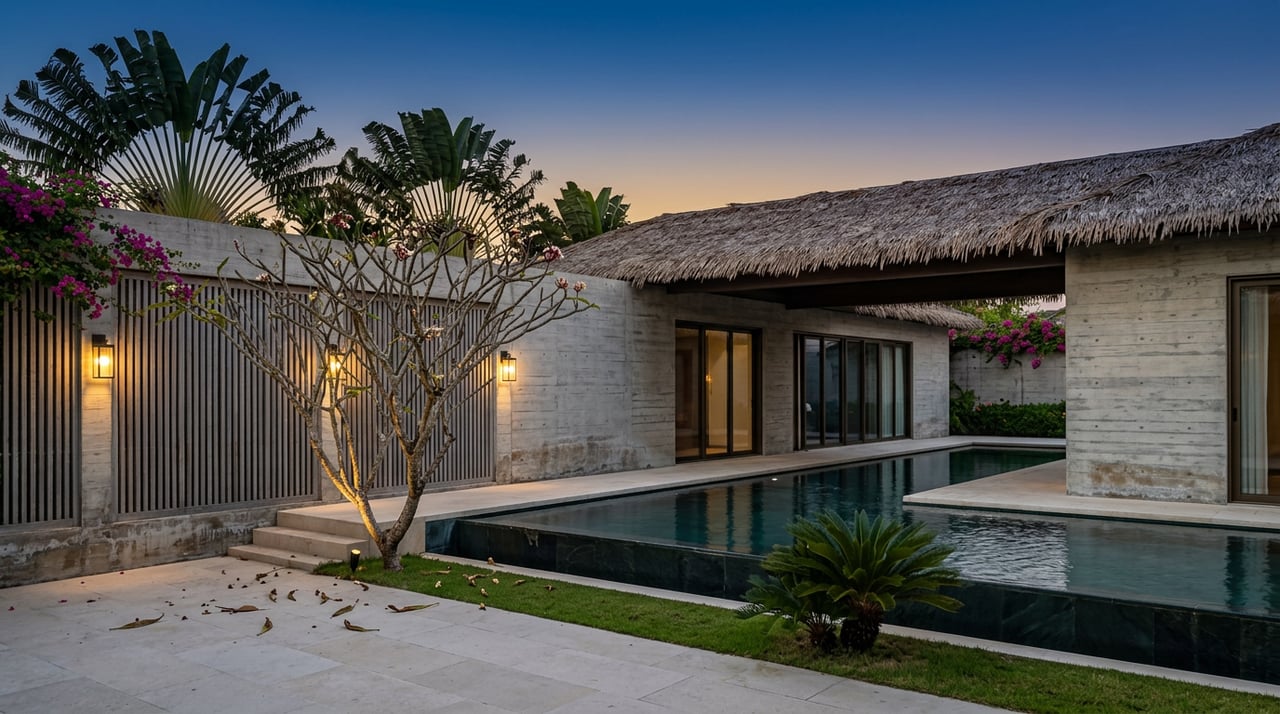
Walk five minutes outside the village boundary in either direction and the ownership structure changes entirely. Catalina Cove and Mar Vista, the gated developments that ring the historic core, sit on titled land. Brokers marketing lots in those communities list homesites starting around $150,000, with finished homes running from the mid six figures into seven figures depending on size and finish.
| Village core (Maritime Zone) | Surrounding titled developments | |
|---|---|---|
| Ownership type | Municipal concession, fixed term | Fee-simple title |
| Typical financing | Cash or private terms; conventional mortgages rarely apply | Bank and international financing generally available |
| Resale process | Requires concession transfer approval | Standard title transfer |
| Proximity to CRIA/La Paz | Often closest on the map | A short drive, comparable in practice |
As of mid-2026, industry price tracking put the broader Flamingo-Potrero corridor rising somewhere in the 14 to 18 percent range year over year, while the Flamingo-Brasilito-Potrero area as a whole was still described as offering slightly better value than Tamarindo or Nosara for comparable beach access, with a typical two-bedroom listing in the $350,000 to $550,000 range as of July 2026. That "better value" framing is accurate, but it's worth being precise about where inside Brasilito it applies. It's describing the titled side of town. The concession side isn't cheaper because it's undiscovered. It's priced the way it is because a meaningful share of buyers, and nearly every conventional lender, simply can't transact on it the same way.
Why the Village Persists Anyway
None of this means the village core is going away, or that it should be read as a problem to be solved. Families have lived inside that zone for generations, the plaza still functions as the actual center of town, and the same reporting that documents the eviction history also documents a community that has organized around staying put. The zoning status is a legal fact about what you can buy and how, not a judgment on the neighborhood itself.
For a buyer, the practical takeaway is narrower: don't assume that "walking distance to CRIA" or "closest house to La Paz" tells you what kind of ownership you're getting. In Brasilito more than most Gold Coast towns, proximity and title are two separate questions, and the second one determines almost everything about financing, resale, and long-term hold.
What to Verify Before You Fall for the School-Run Pitch
- Ask directly whether the specific property carries fee-simple title or a maritime zone concession, and get it in writing before you make an offer
- If it's a concession, check the remaining term and the renewal history with the local municipality
- Confirm with your lender early whether they'll finance concession property at all, since many won't
- If a listing markets its walk to CRIA or La Paz as a selling point, ask which side of the zone boundary the parcel actually sits on
- For titled developments like Catalina Cove or Mar Vista, confirm the title is clear and registered in the National Registry before signing anything
Frequently Asked Questions
Can I get a mortgage on a concession property in Brasilito's village core? Generally, no, at least not through the conventional lenders that finance titled beachfront elsewhere in Guanacaste. Concession purchases in Costa Rica are typically cash transactions or use private financing arranged directly between buyer and seller. Confirm this with your own lender before assuming otherwise.
Does buying in Catalina Cove or Mar Vista mean I avoid Maritime Zone issues entirely? In most cases yes, since those developments sit on titled land outside the restricted zone, but title status should still be verified parcel by parcel through the National Registry rather than assumed from the development's reputation.
Why hasn't the village core simply been titled after decades of the same arrangement? Because the Maritime Zone framework itself, not local inertia, is what restricts titling within that strip of coast. Changing that would require action at the level of national maritime law, not a local rezoning.
Brasilito rewards buyers who ask the tenure question before the amenity question. If you're weighing a property near either school, or comparing Brasilito against Flamingo, Potrero, or Tamarindo more broadly, talk to a local expert who can walk the specific parcel with you before you fall for the drop-off radius alone. Gold Coast Realty has spent years on this stretch of coast and can tell you, parcel by parcel, which side of the line you're actually buying on.