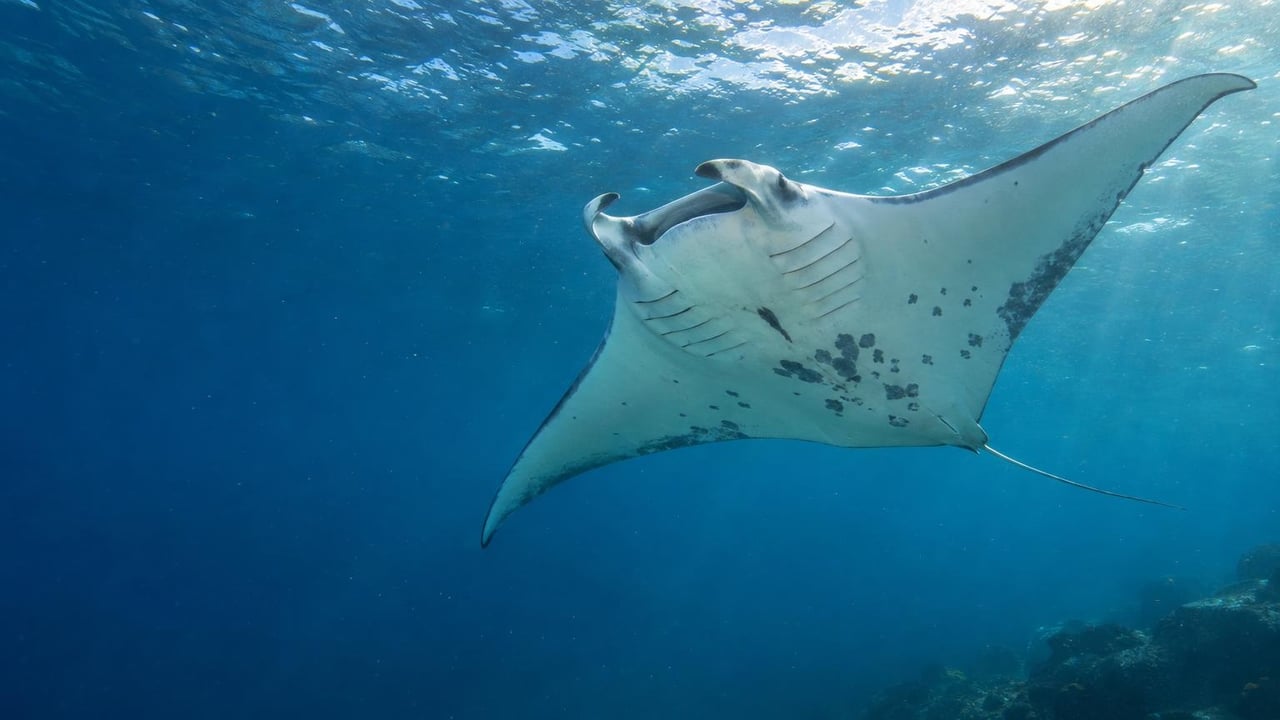
Some of the giant mantas that visit the cleaning stations at the Catalina Islands have also been photographed at Cabo Blanco and Caño Island, far down the coast. A study published in Frontiers in Fish Science in October 2026 pulled together the photo-identification records of a collaborative network of researchers and divers. It counted 19 resightings of mantas traveling from Cabo Blanco, at the southern tip of the Nicoya Peninsula, to Las Catalinas, made by 4 individual rays. It also counted 12 resightings from Caño Island to Las Catalinas, made by 6 rays. Northward trips from the southern hubs toward the Catalinas accounted for 72.1% of all the photo links in that network.
Those matches were made from photographs, and many of the photographs came from people who were diving for fun. The study's methods describe a database built partly from "opportunistic imagery provided by a collaborative citizen-science framework consisting of recreational divers and local dive operators." Dive shops in Flamingo count the dry season that starts in December among their most consistent manta months, so for anyone in Playa Potrero or Flamingo with a camera and a wetsuit, the coming weeks are a good time to add to that record.
December Changes the Water First
The Catalinas season turns on the Papagayo winds. One local operator's seasonal guide at scubadivecostarica.cr describes December through March as dry, sunny and windy. In those months the Papagayo winds pull colder, nutrient-rich water up from depth, and divers often meet distinct thermoclines below a warmer surface. The same guide calls December through May the most consistent window for manta rays at the Catalinas. Rocket Frog Divers in Playa Flamingo puts the dry season at December to early May. It says manta sightings tend to peak in that window and that a 3mm wetsuit suits most divers, with a 5mm for anyone who runs cold.
The typical seasonal ranges from that operator guide show the tradeoff:
| Period | Water temperature | Typical visibility | Conditions |
|---|---|---|---|
| December–March | About 20–24°C | About 10–20 m | Dry, sunny, windy; upwelled water |
| April–May | About 23–27°C | About 15–25 m | Winds ease, visibility often improves |
| June–August | About 26–30°C | About 15–25+ m | Warm, afternoon and overnight rain |
| September–November | About 25–29°C | About 10–20 m | Wetter; September and October wettest; variable |
Day to day, the water swings well beyond those ranges. Pacific Coast Dive Center posts dated condition reports by site. At Clásico/Norte on December 16, 2025, it logged 26°C water with 4 meters of visibility. The next day at the same site it logged 24°C and 15 meters. On January 28, 2026, Clásico/Norte read 23°C and 12 meters while Pailas/Sur read 25°C and 8 meters. By May 4, 2026, the water had warmed to 28°C at both sites. Rocket Frog describes the cooler, cloudier layer under a thermocline as the nutrient-rich water where large animals are often feeding.
Where the Mantas Turn Up
The same Pacific Coast Dive Center log shows the season playing out last year. It recorded devil rays at Clásico/Norte in December 2025. Its 2026 manta sightings came at Clásico/Norte on January 28 and March 10, and at Sombrero on March 27. Rocket Frog says the Catalinas have more than twenty named sites. The ones it lists for mantas are The Point and The Cleaning Station, South Point/El Jardin, and the point at the end of The Wall on the largest island in the chain. Pacific Coast Dive Center names Cuatro Piedras as a manta site when the currents allow. Every operator that writes about it says a manta is never guaranteed.
The cleaning stations explain the morning boat schedules. The study describes nearshore rocky reefs as places where small fish clean parasites and dead tissue off the mantas, and as places where the rays socialize and court. Across the study's coastal receivers from 2018 to 2025, 98.06% of manta detections came between 6:00 a.m. and 5:59 p.m. The authors link that to the cleaner fish, which forage by sight in daylight. After dark the mantas move offshore to feed in open water.
The study also records a difference in protection. The Murciélago Islands sector of Santa Rosa National Park and the Cabo Blanco reserve are fully protected no-take areas. The study describes the Catalinas as a series of rocky reefs that "currently lacks a formal marine protected area status." The Tico Times covered the study on October 23, placing the Catalina Islands "near Playa Flamingo." It reported that collisions with boats and injuries from propellers and fishing lines are among the threats to the species. ConnectOcean, the dive center on the lower level of Marina Flamingo, lists work toward a marine protected area around the Catalinas among its conservation goals.
The Photo the Researchers Need
Mantas are told apart by the spot pattern on their bellies, and that is the shot that matters. The study matched individuals by "ventral pigmentation profiles and unique spot patterns." A picture of a manta's back makes a good souvenir, but only a picture of its underside can identify it.
Mantas Costa Rica, the project behind the study, was set up in 2021 by Iguana Divers and the marine conservation group CREMA. Its project page reports a database of more than 120 mantas identified in Costa Rica and says photo-ID data from citizen divers is uploaded to the Manta Trust. The Manta Trust sends sightings from outside the Maldives, Costa Rica included, to its MantaBase submission form. The form takes submissions from the "General Public / Tourist," with up to five photos and the date, time, site, country and region of the encounter. The trust asks for the whole underside of the manta if possible. Large files or video can be arranged by emailing [email protected]. MantaMatcher also accepts belly photos or video, with the place and time of the sighting, for researchers to review and match.
Local groups have built events around the same photos. The Clean Wave, the beach cleanup group we covered in our post on its work in Langosta, advertised a manta-identification dive at the Catalinas for April 11, 2026. BA Divers was the diving sponsor, and divers were invited to take ID photos. ConnectOcean's citizen-science dives log fish, sharks, rays and boat traffic around the Catalinas and upload the data through an ArcGIS mobile app.
A good belly photo depends on how the diver behaves. The Manta Trust's code of conduct asks divers to enter the water calmly at least 10 meters from a manta, to stay outside 3 meters, and to approach from the side. It also asks divers not to chase or touch the animal, to stay low and beside a cleaning station rather than on top of it, and never to block a manta's path. Rocket Frog's guidance for the Catalinas is to hover rather than chase and to look without touching.
Getting Out From Potrero
Most Catalina trips leave in the morning and are back by early afternoon, and the prices below are each shop's listed rates before the 13% tax. ConnectOcean runs its tours from Marina Flamingo and lists a two-tank Las Catalinas trip at $150 per person, from 7:45 a.m. to 1 p.m. Pacific Coast Dive Center charges $140 for two guided dives at different sites. Check-in at its shop is 7:30 a.m., return is about 1 p.m., and the boat ride out takes roughly 40 minutes. Its $15 round-trip shuttle covers pickup points that include Potrero, Brasilito and Flamingo. Rocket Frog Divers lists two Catalina tanks at $85 and three nitrox tanks at $155. Snorkelers and boat passengers ride for $50, and a full rental gear set is $30.
The wind affects snorkelers more than divers. The operator guide notes that December-through-March mornings can bring calm surface conditions, while the stronger afternoon wind makes some locations less comfortable. That fits the early departures, and it fits the mantas' daylight hours at the cleaning stations too.
Several of the mantas in the study's records came north from Cabo Blanco and Caño Island to reach the Catalinas, and the next match could come from a photo taken on a morning trip out of Flamingo. If you live in Playa Potrero or Playa Flamingo and have questions about the coast you live on, the team at Gold Coast Realty lives and works on this stretch of Guanacaste and is glad to talk it through. Talk to a local expert.